


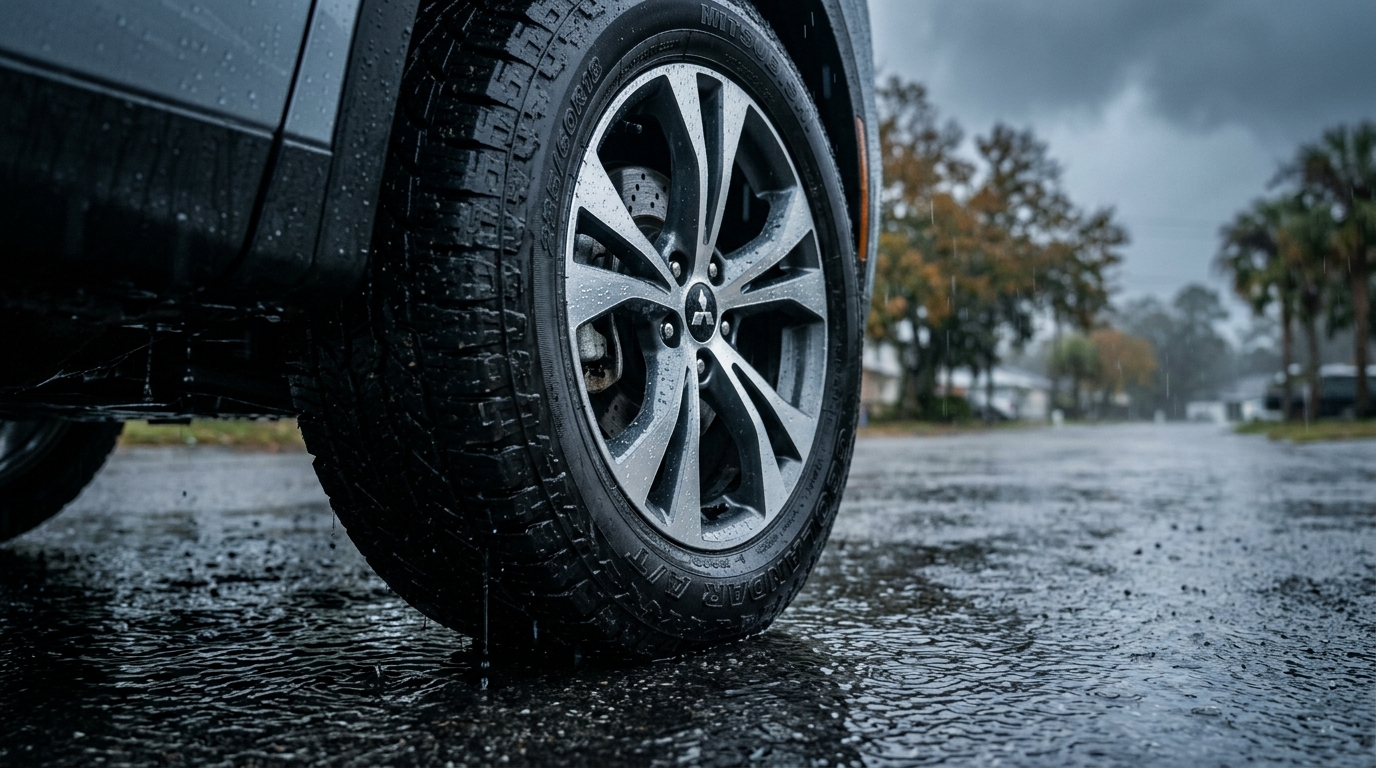
 How to Prepare Your Mitsubishi for Fall Storm Season and Highway Commutes in Pinellas County
Preparing your Mitsubishi for fall storm season and daily highway commutes requires inspecting tire tread depth, verifying brake pad thickness, replacing UV-worn wiper blades, and testing your battery. Ensuring your tire tread stays above 4/32 inches and your braking system is clear of salt-air corrosion gives your vehicle the grip and stopping power needed during sudden downpours on fast-moving highways.
As Service Manager at St. Pete Mitsubishi with 25 years of automotive experience, I see firsthand how extreme coastal weather affects local vehicles every autumn. Fall in West-Central Florida brings severe afternoon thunderstorms, tropical weather threats, and slick highway surfaces along major corridors like I-275 and US-19. Preparing your vehicle before the heavy rains arrive is the best way to stay safe during your daily drive.
When you bring your vehicle to our Seminole service center, our technicians review every major safety system to ensure your vehicle is ready for severe weather. From verifying wheel torque to checking your charging system, taking proactive steps now prevents unexpected breakdowns during heavy rainstorms. If you ever have questions about seasonal maintenance, give a quick call to our service desk and my team will guide you through the process.
Table of Contents
- How Often Should Tires and Brake Pads Be Inspected for Wet Highway Driving?
- How Mitsubishi Super All-Wheel Control S-AWC Prevents Hydroplaning on Heavy Rain Corridors
- Why Coastal Salt Air Accelerates Brake Rotor Corrosion and How Multi-Point Safety Inspections Help
- How the Mitsubishi Outlander PHEV Hybrid System and Power Outlets Perform During Storm Season Commutes
- How Wiper Blade Degradation and Tire Pressure Adjustments Protect Your Commute
How Often Should Tires and Brake Pads Be Inspected for Wet Highway Driving?
Tires and brake pads should be inspected every 6,000 miles or at the start of fall storm season, ensuring tread depth remains above 4/32 inches and brake pads stay thicker than 3 millimeters. Driving on water-covered highways demands maximum channel depth to shed standing water and sufficient friction material to stop safely in reduced-visibility conditions.
While the legal minimum tread depth in Florida is 2/32 inches, that depth is inadequate for high-speed rain driving. At 2/32 inches, a tire loses up to 70 percent of its ability to displace standing water compared to a new tire, significantly increasing your risk of hydroplaning. During our routine maintenance visits, we measure tread depth across the inner, center, and outer grooves using a digital gauge to identify uneven wear early.
Brake pad thickness is equally vital when stopping distances double on wet pavement. Our factory-trained technicians check both the inner and outer brake pads on each wheel assembly. We also evaluate rotor thickness, surface scoring, and caliper slide operation. You can easily schedule a service appointment online to have your braking and tire systems thoroughly inspected before storm season peaks.
How Mitsubishi Super All-Wheel Control S-AWC Prevents Hydroplaning on Heavy Rain Corridors
Mitsubishi Super All-Wheel Control prevents hydroplaning by monitoring wheel speed, steering angle, yaw rate, and engine torque in real time to transfer power to the wheels with the best traction. By managing Active Yaw Control and engine braking, the system stabilizes the vehicle instantly when encountering standing water on highway lanes.
Along the low-lying waterfront stretches near St. Petersburg, where severe afternoon storms quickly leave standing water on expressways, Super All-Wheel Control provides exceptional driver confidence. The system uses sensors at all four wheels to detect slipping long before a driver feels a loss of control. When the front tires encounter pooling water, S-AWC automatically directs drive torque to the rear wheels while applying light braking to the slipping inside wheel.
Unlike traditional four-wheel-drive setups that lock axle speeds, S-AWC integrates engine management, power steering assistance, and anti-lock braking. On vehicles like the 2026 Mitsubishi Outlander and 2026 Mitsubishi Eclipse Cross, selectable driving modes tailor system intervention specifically for wet or slippery road surfaces. This electronic coordination maintains directional stability even when changing lanes through highway ruts filled with rain.
Why Coastal Salt Air Accelerates Brake Rotor Corrosion and How Multi-Point Safety Inspections Help
Coastal salt air accelerates brake rotor rust and caliper binding by causing rapid oxidation on iron surfaces, leading to uneven pad wear, squealing, and diminished stopping power. A comprehensive multi-point safety inspection catches surface pitting and slide-pin corrosion early, ensuring hydraulic pressure distributes evenly across all four wheels.
Living near the Gulf Coast exposes vehicle undercarriages to airborne sea salt and ocean humidity year-round. Over time, salt residue builds up on caliper brackets and brake pad guide channels. This buildup can cause brake pads to drag against the rotor, generating excessive heat and premature rotor warping. During a complimentary multi-point inspection, our technicians check for:
- Surface oxidation and pitting on front and rear brake rotors
- Caliper pin lubrication and rubber dust boot integrity
- Brake fluid moisture content and hydraulic line condition
- Undercarriage metal components and suspension mounting points
Catching small salt-air corrosion issues early prevents expensive component replacements down the road. Cleaning friction surfaces and lubricating caliper slide pins during routine tire rotations ensures your braking system reacts immediately when you hit the pedal in emergency rain situations.
How the Mitsubishi Outlander PHEV Hybrid System and Power Outlets Perform During Storm Season Commutes
The 2026 Mitsubishi Outlander PHEV combines a 2.4L four-cylinder engine with dual electric motors and a 22.7-kWh battery pack to provide up to 45 miles of all-electric driving range and 297 horsepower for confident highway passing. During power outages, its built-in 1,500-watt 120V AC power outlets deliver electricity directly from the traction battery to power small household appliances and emergency electronics.
Drivers commuting along busy highway routes enjoy seamless transitions between electric and hybrid power modes. The dual electric motor layout provides instantaneous torque, helping you accelerate briskly onto fast-moving expressways even in torrential downpours. Backed by Mitsubishi's 10-year/100,000-mile limited powertrain warranty and a 10-year/100,000-mile hybrid component warranty, the plug-in hybrid system offers long-term reliability and efficiency.
If severe storms disrupt power in your neighborhood, the Outlander PHEV serves as an onboard energy reservoir. The twin 1,500-watt power outlets located in the rear cargo area and center console can run microwave ovens, portable refrigerators, work lights, or laptop chargers during extended electric outages. Drivers looking for versatile family transportation can explore new Outlander PHEV models, browse our full lineup of new Outlander SUVs, or check out compact options like new Outlander Sport crossovers.
How Wiper Blade Degradation and Tire Pressure Adjustments Protect Your Commute
Wiper blades in humid Florida climates should be replaced every 6 to 12 months because intense sun, heat, and ozone split the rubber edge and cause streak-filled windshields during torrential downpours. Maintaining recommended tire pressure between 32 and 35 PSI prevents uneven tread wear and ensures the tire footprint properly evacuates water on slick highway asphalt.
For commuters driving along the coastal corridor toward Clearwater, salty morning humidity and high highway speeds make proper tire inflation and streak-free visibility absolute necessities. Drivers coming into our service bay before storm season usually ask how often wiper blades really need to be changed in Florida heat, and I show them how UV rays split the flexible rubber edge long before the blade ever visibly tears. Replacing worn blades with genuine Mitsubishi sightline wiper blades restores complete clarity in heavy rain.
Checking tire pressure monthly is equally critical as ambient temperatures shift. Under-inflated tires compress in the center of the tread, lifting the outer edges and reducing water displacement capability, which drastically increases hydroplaning risks at highway speeds. Always check your tire pressures when the rubber is cool, referencing the spec label on the driver's door pillar rather than the maximum pressure listed on the tire sidewall.
If your vehicle is due for storm preparation, drop by our dealership facility on Park Boulevard or give our service advisors a call directly at (727) 435-1654. If you ever encounter an unexpected road emergency, remember that every new vehicle is backed by 5 years/unlimited miles of roadside coverage through Mitsubishi Roadside Assistance at 1-800-222-0037. My team and I are here to keep your vehicle running safely, smoothly, and reliably all season long.