


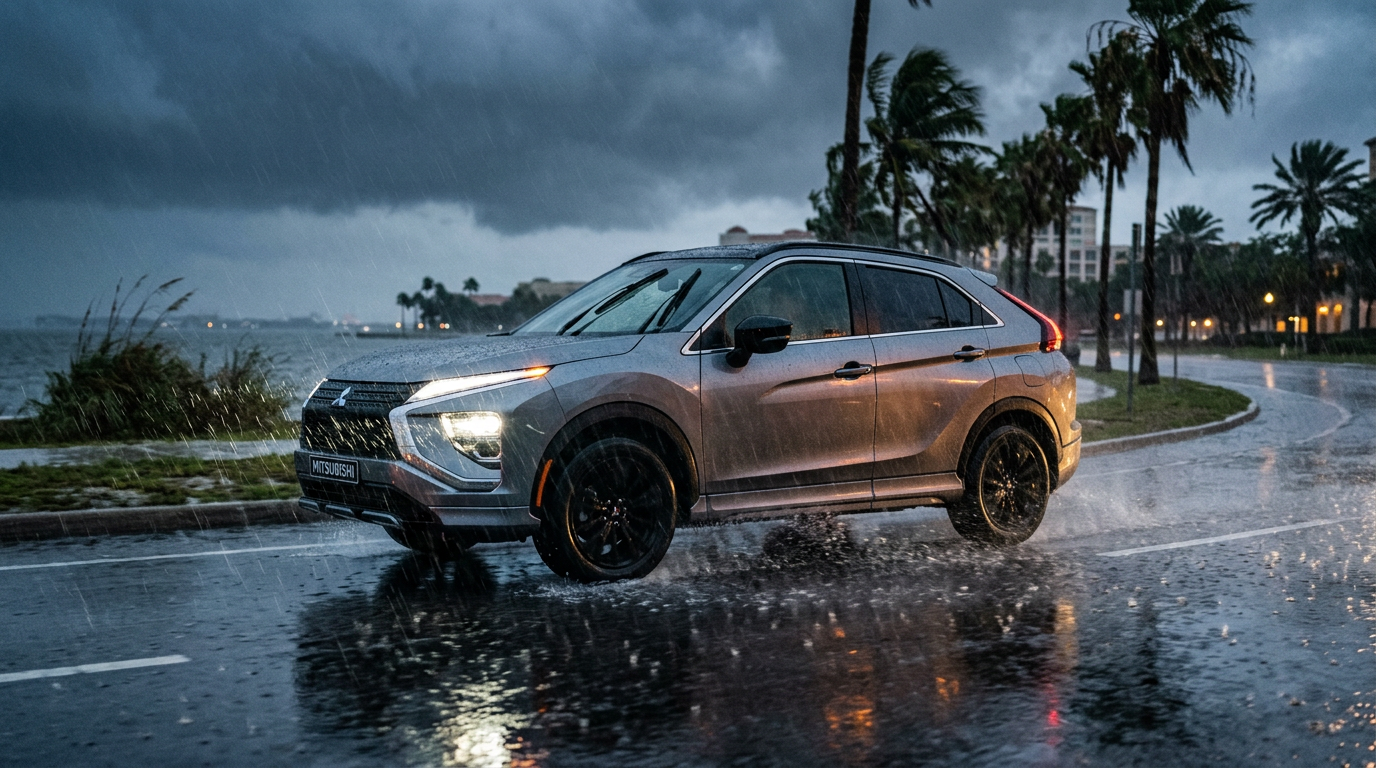
Today, we are interviewing Mike Camerino, the Service Manager at St. Pete Mitsubishi. With 25 years of automotive maintenance and safety experience, Mike is uniquely qualified to help local drivers navigate the unique challenges of the rainy season. In this interview, he shares critical advice on managing speed, understanding tire mechanics, and avoiding common wet-weather driving mistakes to keep your family safe on the road.
Q: Mike, how should drivers adjust their speed and visibility when a sudden Florida downpour hits?
A: When a tropical storm system rolls across the Gulf, the transition from bright sunshine to a blinding wall of water happens in an instant. For commuters heading home along the subtropical waterfront routes of St. Petersburg during a sudden 4:00 PM deluge, visibility can drop to near zero in seconds. Florida law requires motor vehicle headlights to be turned on any time windshield wipers are in use due to rain, smoke, or fog, and from sunset to sunrise. This is not just about seeing the road ahead, but ensuring other drivers can see you through the heavy spray.
The National Highway Traffic Safety Administration advises that drivers should reduce speed and increase following distance on wet roads because stopping distances can more than double on slick surfaces compared with dry pavement. In heavy rain, it is recommended to increase your normal dry-weather following distance to at least 5 to 6 seconds to allow for longer stopping times and to reduce the chance of rear-end collisions. If you need assistance preparing your vehicle for these conditions, you can stop by our Seminole showroom or give our service department a call at (727) 616-2033 to ensure your vehicle is ready for the storms.
Q: How does tire tread depth directly affect a vehicle's ability to resist hydroplaning?
A: Many drivers believe that as long as a tire has some visible grooves, it is perfectly safe for wet roads, but the physics of water displacement tell a very different story. A typical passenger car tire has about twenty square inches of footprint surface that must maintain direct contact with the road. The grooves in your tire tread act as channels to pump water away from this footprint. When these grooves wear down, their capacity to channel water decreases significantly, forcing the tire to ride on a thin layer of liquid instead of the asphalt.
While Florida law deems tires legally worn at a tread depth of 2/32 of an inch, safety experts and organizations like AAA recommend replacing tires when they reach 4/32 of an inch of remaining depth to maintain reliable wet-weather traction. In testing, vehicles equipped with the legal minimum of 2/32 of an inch took about 100 more feet to stop from 70 mph compared to tires with 4/32 of an inch of tread. To ensure your tires are up to the task, you can schedule service online at our specialized facility. If you are considering upgrading to a highly reliable vehicle, we invite you to explore our quality pre-owned SUVs or browse our complete used vehicle inventory.
Q: Mike, what is the correct procedure if a driver starts to hydroplane on a slick road?
A: The sensation of losing connection with the asphalt is terrifying, but your immediate reaction determines whether you glide safely through or lose control completely. If your vehicle begins to hydroplane, the most critical step is to remain calm and ease your foot off the accelerator. You must avoid slamming on the brakes or making sudden steering movements, as these actions will cause the vehicle to spin once the tires regain traction. Keep the steering wheel pointed straight and allow the vehicle to slow down naturally until you feel the tires re-establish contact with the road.
"The absolute worst thing you can do when your tires lose contact with the asphalt is panic and slam on the brakes."
Modern safety technologies can also assist in these moments. Our current new vehicle inventory features advanced traction control systems designed to help manage slippage. If you are looking to transition to a safer vehicle, our finance team can assist you with options like bankruptcy auto loans to help you rebuild your credit while staying safe. Additionally, if your current vehicle requires urgent maintenance to prevent hydroplaning, we offer service now, pay later options to keep your family protected without financial stress.
Q: How deep can water be before it becomes dangerous, and what are the specific risks of saltwater?
A: While a puddle might look harmless, driving through standing water of unknown depth is one of the most expensive gambles a motorist can make in Florida. Water as shallow as 6 inches can reach the bottom of many passenger cars, causing loss of control or stalling the engine. When water reaches 12 inches or more, it can actually float and move smaller vehicles, completely removing any steering control. This is a major concern on low-lying coastal roads near Clearwater, where recent flash floods have trapped drivers on barrier islands and forced them to abandon water logged vehicles.
Furthermore, driving through saltwater flooding around coastal areas causes severe, long-term damage. Saltwater is highly corrosive and can destroy electrical components, contaminate critical lubricants, and accelerate rust on undercarriage parts. If your current vehicle has suffered water damage, you can value your trade-in online to see your options. To protect your next vehicle from unexpected mechanical failures, we highly recommend looking into our Triton vehicle protection plans. You can also explore our new Mitsubishi Eclipse Cross inventory, which features excellent ground clearance to help navigate unpredictable weather safely.
Q: What are the most common driving mistakes motorists make during our daily afternoon storms?
A: One of the first things I notice during our afternoon storm season is how many motorists treat a torrential downpour like a standard, dry-weather highway commute. A major mistake is using cruise control on wet roads, which can prevent your vehicle from automatically reducing power when it begins to hydroplane, leading to a complete loss of control. Another frequent error is tailgating, which ignores the fact that wet roads require twice the stopping distance. Additionally, driving with hazard lights on while moving can confuse other drivers who may think you are stopped, though if conditions become so severe that visibility is completely lost, emergency managers advise pulling safely off the roadway, turning on your hazard flashers, and remaining in the vehicle until the storm passes.
To keep yourself protected, ensure you drive a vehicle equipped with modern safety systems. You can browse our inventory under $30k for a dependable option, and submit our online credit application to get pre-approved. Every new vehicle we sell also comes with a comprehensive complimentary roadside assistance package, giving you access to manufacturer-backed emergency support. If you ever experience a breakdown, you can reach out directly to Mitsubishi Roadside Assistance: 1-888-648-7820 for immediate help.
Q: How do teen drivers fare in these storms, and does our extreme summer heat affect brake safety?
A: Inexperience combined with poor road conditions is a recipe for trouble, which is why we place such a strong emphasis on driver education and vehicle readiness. Crash data consistently shows higher fatal crash involvement rates for teen drivers compared with adults, and adverse weather magnifies this risk due to their limited time behind the wheel. We always advise parents to practice wet-weather driving with their teens in controlled environments before they face a major storm alone.
At the same time, Florida's extreme summer heat can directly degrade your braking system. High temperatures contribute to brake fade and brake fluid degradation over time, which reduces your stopping power when you need to perform an emergency stop in a heavy downpour. To keep your family safe, we offer specialized bad or no credit financing options to help young drivers get into modern, safe vehicles. You can also check our service specials for discounts on brake inspections, or explore our new Mitsubishi Outlander Sport inventory, which features advanced safety technologies to protect less experienced drivers.
Q: What practical steps should drivers take to prepare their vehicles for the daily storm season?
A: Preparing your vehicle for the summer downpour season doesn't have to be complicated, but it does require a proactive approach to routine maintenance. Replacing your windshield wiper blades at least once a year, or sooner if they leave streaks, is one of the simplest and most effective ways to maintain visibility. You should also regularly inspect your tires for proper inflation and tread wear to ensure they can channel water effectively.
If you are ready to ensure your vehicle is fully prepared, please visit our dealership showroom in Seminole or call us directly at (727) 616-2033 to speak with our service team. If you are looking to upgrade to a spacious family vehicle with excellent wet-weather capabilities, you can explore our new Mitsubishi three-row SUVs. Our finance experts are ready to help you decide whether to lease or finance your next vehicle, and we can help you learn about our Mitsubishi VIP purchase program to see if you qualify for more information.
© 2026 St. Pete Mitsubishi. All rights reserved.